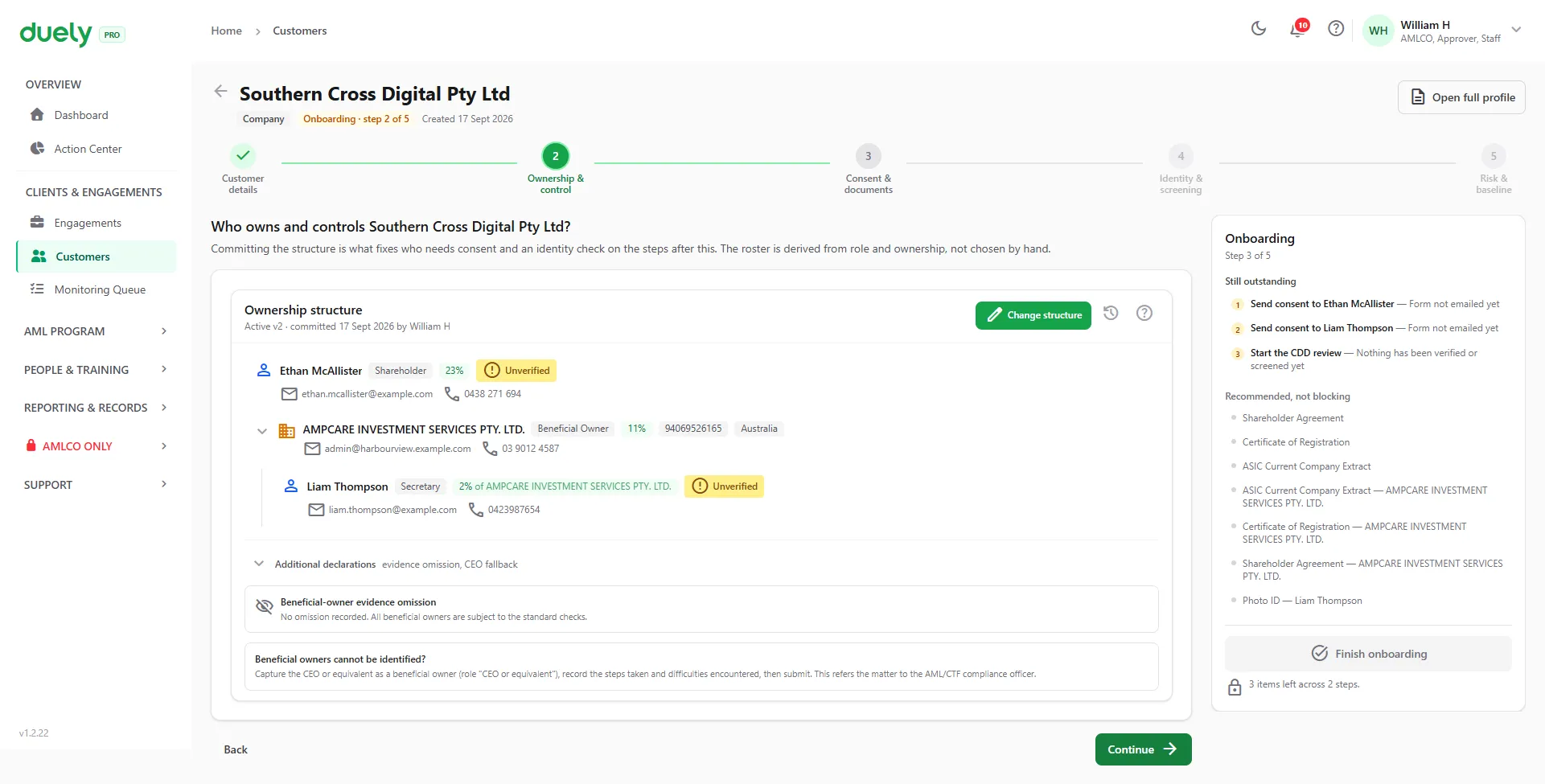
You can stop digging when the search reaches a person who meets either of the two tests below. Every layer before that person is still part of the search.
Australian businesses captured by Tranche 2 became reporting entities on 1 July 2026. A reporting entity is a business that must meet the obligations of the AML/CTF Act 2006 (Cth) because it provides a designated service: a service the Act’s tables list, such as conveyancing, creating or restructuring a company or trust, or real estate agency work. From that date, those firms have to know who stands behind the customers they take on.
A beneficial owner is a natural person who owns 25% or more of a company, trust or partnership, or who controls it. Ownership and control are separate limbs, and someone who owns nothing can still be a beneficial owner.
Identifying beneficial owners is part of customer due diligence (CDD), the process of identifying and verifying who you are dealing with before you provide the designated service. How verification works is covered on the customer due diligence page. This page covers the part of that process where firms get stuck: deciding who counts, and knowing when the search is finished.
The ownership limb: 25% or more
The Act defines beneficial owner in s5, amended by the AML/CTF Amendment Act 2024. The definition has two limbs, and you apply each one separately.
The ownership limb is a threshold: a natural person who owns 25% or more of the entity. The threshold applies per person, so a shareholder holding 30% is a beneficial owner while two shareholders holding 20% each are not, because neither crosses the line. The same arithmetic runs through trusts and partnerships, against the relevant interest in each.
The search starts with the person or entity seeking the service, the applicant for a designated service, and works down through every layer of ownership. Because the definition looks for natural persons, an entity can never be the end of the search. A corporate shareholder is a step on the way, not the finish line.
What counts as a reasonable search scales with the structure. A single-person company needs less work than a chain of companies and trusts. You ask the customer for a structure chart and the governing documents, review the constitution, trust deed or partnership agreement, and trace each layer to the people behind it. The detail of what counts as enough sits in the AML/CTF Rules (2025).
The control limb: substance, not title
Control does not require any ownership at all. Someone who directs how the entity is run, chooses who manages it, or whose say-so is needed for its significant decisions can be a beneficial owner while holding no shares. Control is judged on substance, not on position. A director who only signs what others decide may not be a beneficial owner. The person who actually decides usually is.
The control limb exists because ownership and control part company in practice. A trustee acts for beneficiaries but may take direction from an appointor. A company’s shares can sit with a nominee while someone else makes the calls. In each case you ask the same question: who directs this entity, whatever the paperwork says.
You apply the control limb at every level of the structure, not only at the top. Ownership percentage is not the whole test. Where ownership is spread thinly across many people, the control limb does the work the ownership limb cannot.
The decision table
The deadline is the same for every entity: identification and verification are complete before you provide the designated service, and the records are retained for seven years.
| Entity type | Who counts as a beneficial owner | What you verify |
|---|---|---|
| Company | A natural person who owns 25% or more of the shares or voting rights, or who controls the company | Ownership percentages, control arrangements, and each person’s identity (s5) |
| Trust | The natural persons who ultimately own or control the trust, including whoever directs how it is administered | The trust deed, how the trust operates in practice, and each person’s identity (s5) |
| Partnership | A partner who holds 25% or more of the partnership, or who controls it | The partnership agreement, each partner’s share, and identity (s5) |
The customer identification provisions sit in Part 2 of the Act (initial due diligence in ss 28-29, ongoing due diligence in s 30, and simplified or enhanced due diligence in ss 31-32), and the entity-specific detail is in the AML/CTF Rules (2025).
The record matters as much as the search. For each beneficial owner you record which limb they meet, the documents you relied on, and the reasoning. That record, not the customer’s own description, is what a reviewer looks at, and it is retained for seven years.
Beneficial ownership is not a report you file. You do not lodge a separate beneficial ownership return with AUSTRAC; the work product is the CDD record you hold and can produce on request.
A structure that takes real work to trace is also a signal. Complex ownership is one of the things that pushes a customer toward enhanced customer due diligence (ECDD), the higher level of due diligence for higher-risk customers. The enhanced due diligence page covers the triggers. A convoluted ownership chain is a reason to look more closely, and that page explains when looking more closely becomes a requirement.
What catches people out
Control captures people who own nothing
If your procedure only asks for shareholders, you record the owners and miss the person who actually decides. The consequence is a CDD record that does not answer the question the Act asks, and a reviewer finds you did not know who you were dealing with. The share register will never show the control limb.
Stopping at the first corporate shareholder
A company that owns all of the customer is not a beneficial owner, because the definition looks for natural persons. The search continues through that company to the people behind it. Stopping early leaves an entity in your records where a person belongs, and the same incomplete record feeds every engagement for that customer.
No beneficial owner found: the fallback field
After your reasonable measures, if no natural person meets either limb, you record the person in a senior managing position instead. A blank field is not an available outcome; the fallback exists so that every customer has a person on record. Where the search comes up empty in a way that makes no sense for the entity’s size or activity, that can itself form a suspicion, and a suspicious matter report (SMR), the report to AUSTRAC when you suspect a matter, is due within three business days of the suspicion forming (s41(2)).
What is still unsettled
The beneficial owner definition in s5 was amended by the AML/CTF Amendment Act 2024, and Tranche 2 is the first full compliance cycle in which reporting entities apply the current wording. The exact limb wording should be confirmed against the Act as in force before you finalise a procedure. The AML/CTF Rules were remade in 2025 with new numbering, so guidance that cites rule numbers from the earlier Rules needs re-checking against the current version. Expect AUSTRAC guidance and the first enforcement outcomes to settle how the control limb is applied to trusts and partnerships in practice. Write your procedure now, version it, and plan to revise it as that clarity arrives.
Where to start
Start here.
- Map the ownership chain: document each layer from the applicant down to the natural persons, with percentages at every level.
- Run the control test separately: for each entity in the chain, ask who actually directs it, and record that person even where they own nothing.
- Build in the fallback: when no beneficial owner can be identified, record the person in a senior managing position rather than leaving the field blank.
How duely handles this
Ownership is handled in two layers, because verifying the entity says nothing about the people behind it. The entity is checked against an independent source, and then every beneficial owner and controller is verified separately as an individual. The ownership structure is versioned, the 25% threshold is calculated rather than typed in by hand, and structures that look unusual are flagged. The carve-outs that let you stop short of a full trace follow the AUSTRAC starter kit, including the listed-company omission, which is gated on the entity actually being low risk.