Built for firms that need a defensible record of every decision
Aligned with AUSTRAC's Tranche 2 obligations, end to end.
duely runs each part of Tranche 2 compliance a firm has to operate day to day: risk assessed per designated service, monitoring that follows the service and the risk, a schedule for program reviews, versioned programs and CDD, escalation to the AMLCO, expired-document alerts, and reliance requests in both directions.
Many Tranche 2 tools focus on identity checks, templates, or high-level reporting. duely is built around the full compliance record: customer onboarding, engagement risk, rationale, approval by your AML/CTF compliance officer (AMLCO), isolated suspicious matter handling, and evidence packs.
The screens your team works in
These are real screens from duely, with sample data.
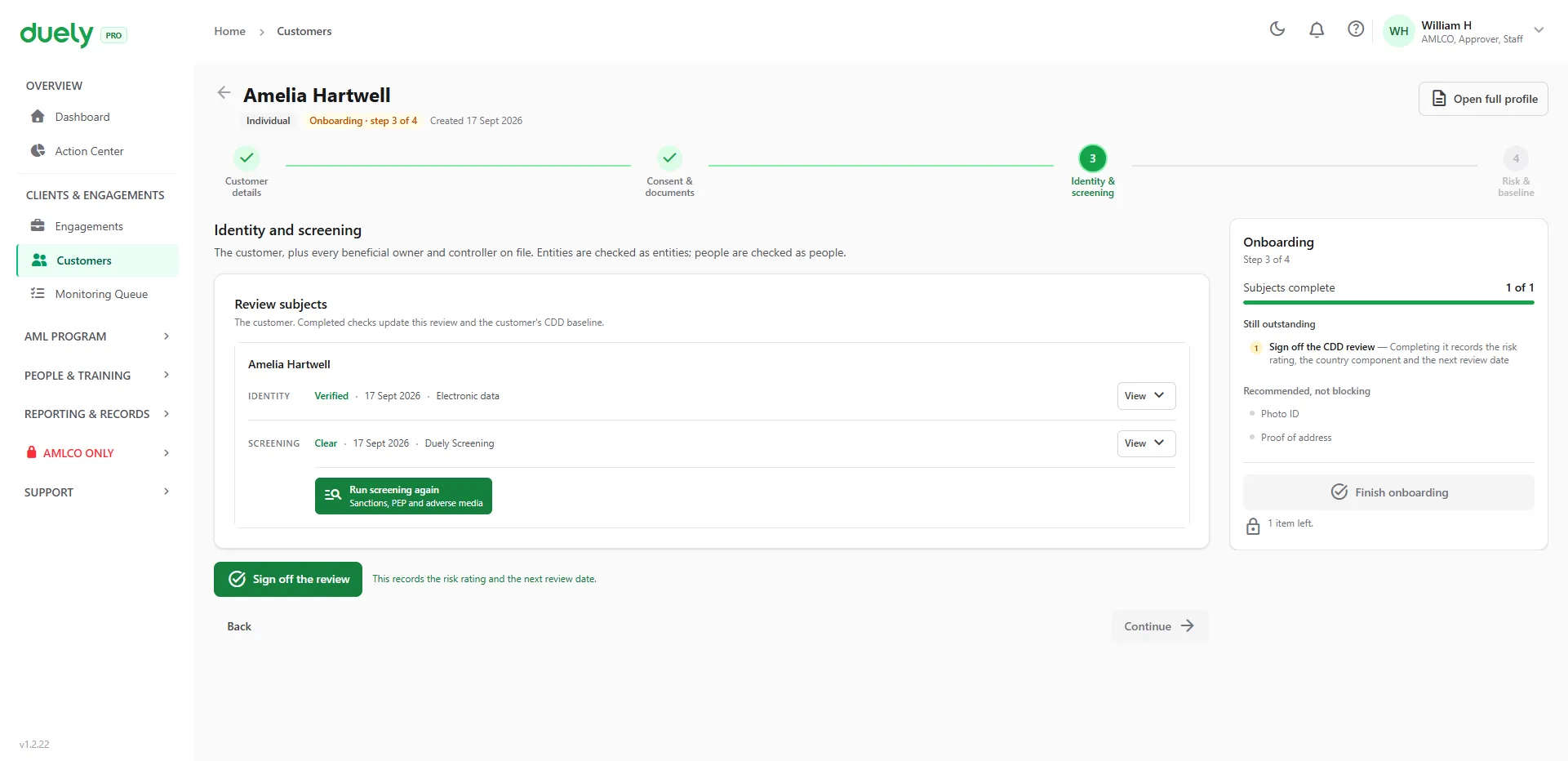
Verify and screen.Identity and screening results sit side by side for each person, with the date and the method used.
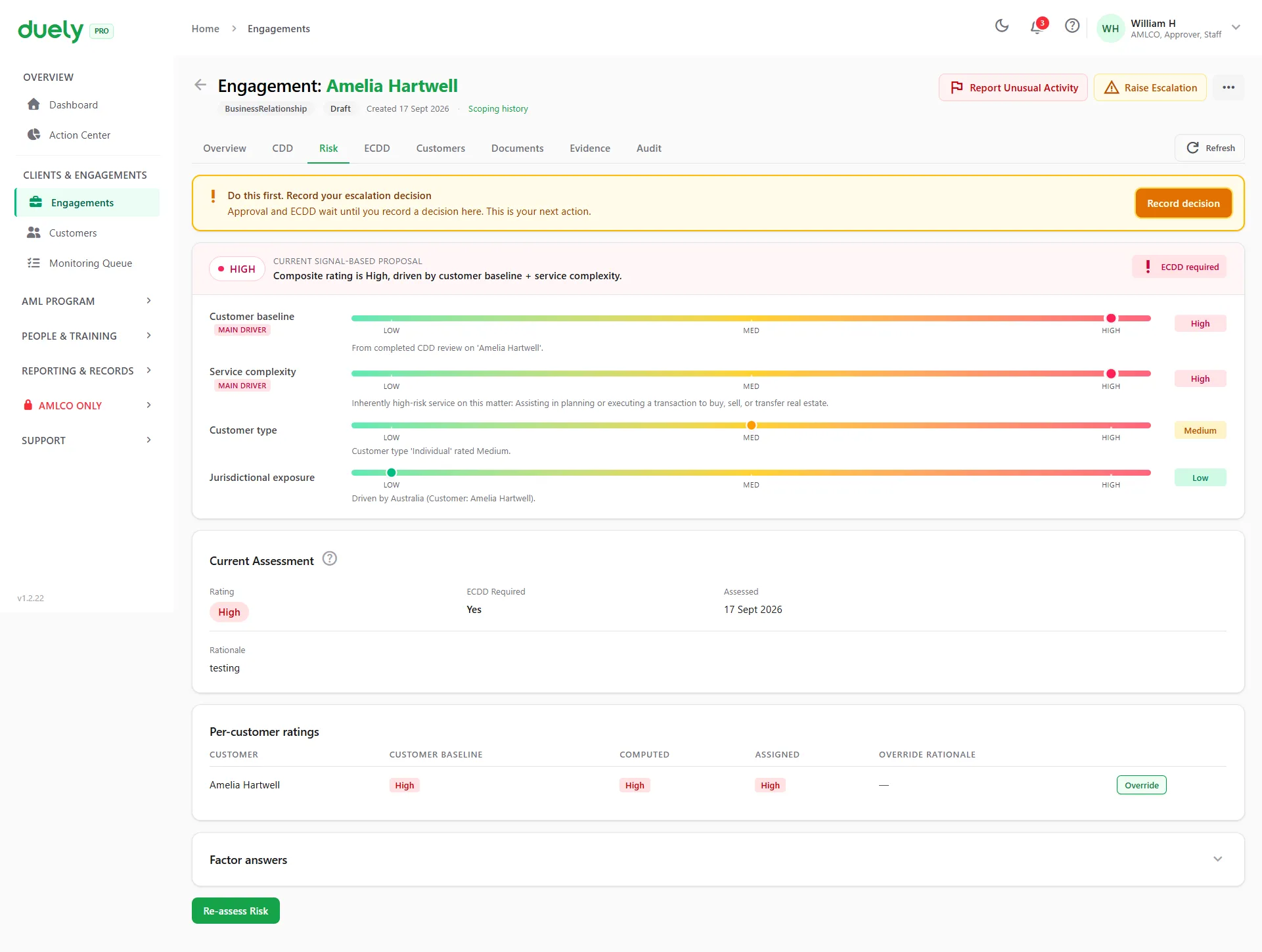
Rate the risk.The answers produce a rating and show what drove it. A High rating opens enhanced due diligence.
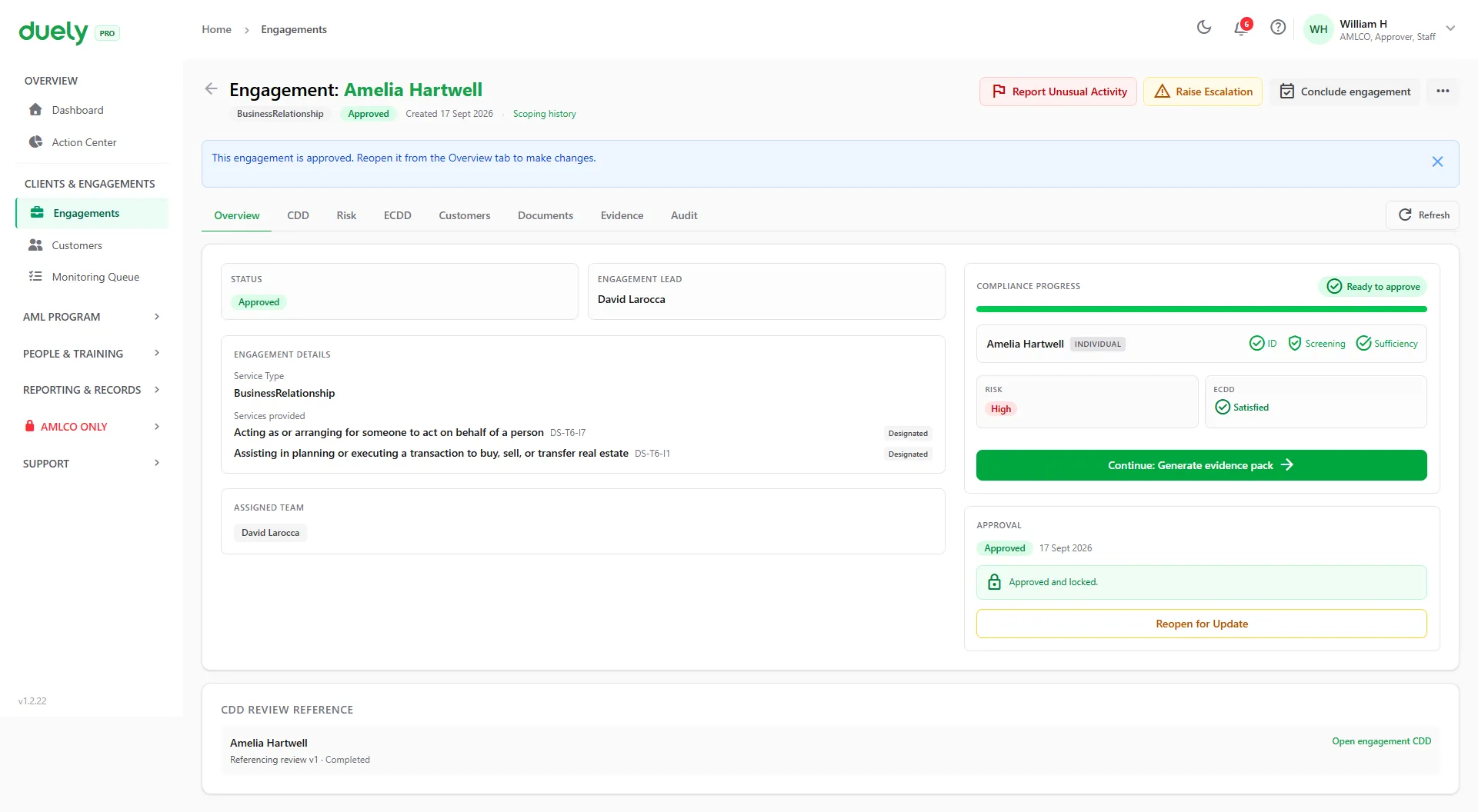
Approve.An approver signs off before the work goes ahead. The approval stays on the record.
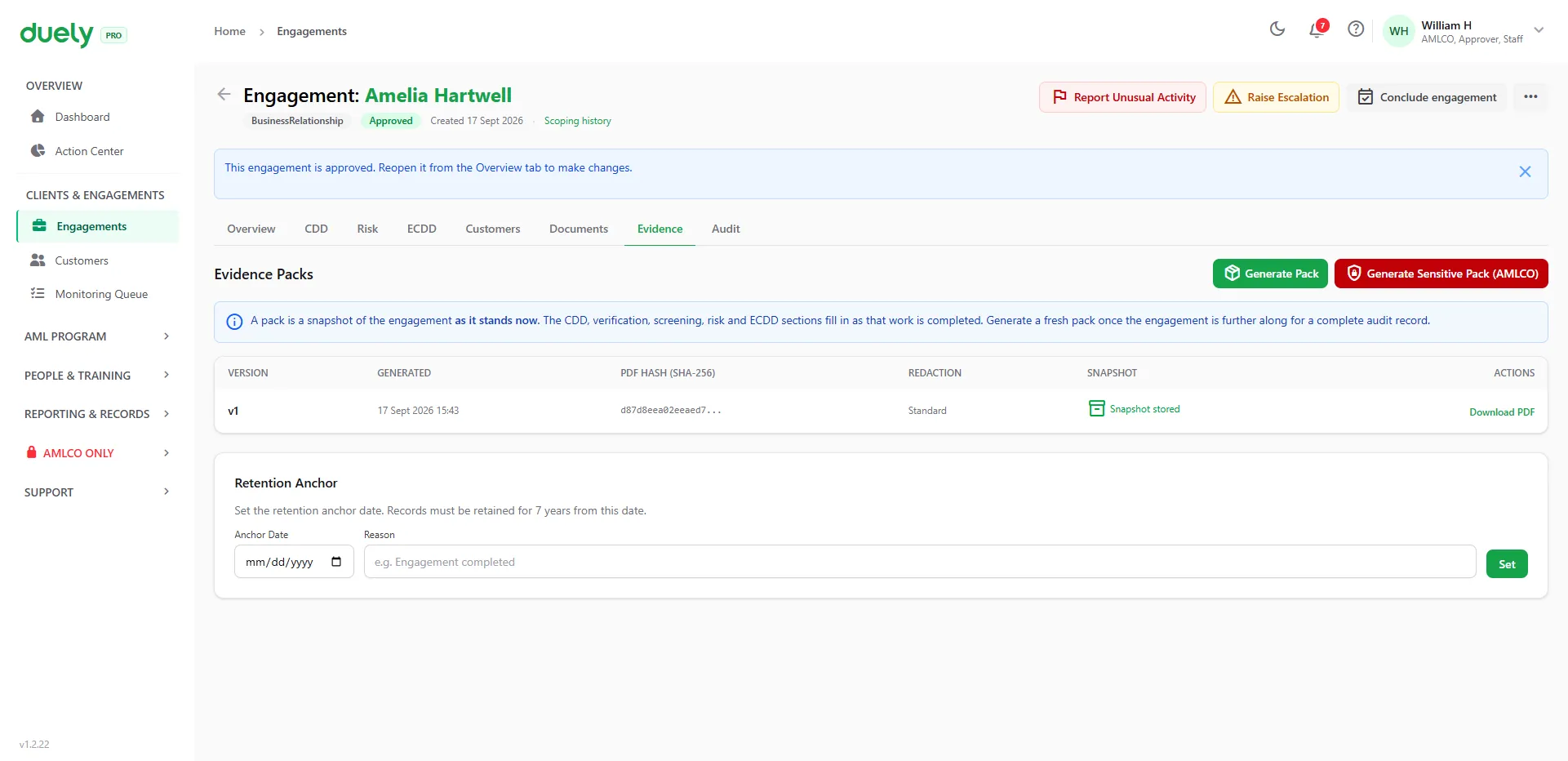
Generate the pack.One PDF, whenever you need it. Each version has its own SHA-256 hash, so any later change to the file can be detected.
What sets duely apart
Many tools cover one part: check-only tools verify identity, program builders write the document, and practice-management add-ons attach compliance to software you already use. The parts that get less attention are enhanced due diligence (ECDD), keeping suspicious matters away from staff so no one tips off a customer, and showing the program keeps working. That is where your firm's liability sits, and these are the design decisions that cover it in duely.
Built to AUSTRAC's Obligations
Every module maps to an obligation in the AML/CTF Act and AUSTRAC's Tranche 2 starter kit, and each runs as a guided step that will not move on until its requirements are met.
Not Tranche 1 Wrapped for Tranche 2
Banks monitor account transactions. Accountants, lawyers and agents provide designated services. Tranche 2 obligations attach to the designated service, so duely assesses risk and monitors at the level of the service and the engagement. You don't hold a transaction feed, and duely doesn't ask you to monitor one.
AUSTRAC XML, SMR 3.0 and TTR
Suspicious matter and threshold transaction reports export as AUSTRAC XML, validated against the AUSTRAC schema before the file is produced.
Versioned Programs and CDD
Every approved AML/CTF program and every CDD review is kept as a version you can open later, so you can show what you knew and decided on any date.
Program Reviews, Scheduled and Done
duely tells you when effectiveness checks, the AMLCO report to the governing body, program and risk assessment review, and the next independent evaluation are due, and gives you the tool to complete each one.
Reliance in Both Directions
Ask another entity for a customer's CDD, and record it on file if they refuse. When another entity asks you, nothing is released until the customer and your firm approve.
Customer-First, Engagement-Led
Onboard each customer once and their due diligence attaches to each engagement automatically. Every engagement goes to an approver, and one that includes a designated service carries its own risk assessment and, where needed, ECDD. An evidence pack is generated on demand.
Evidence-First Workflow
Each compliance step records the decision, rationale, timestamp, actor, approver and a snapshot as the work happens, so every step leaves a defensible record.
SMR Firewall
Suspicious matter handling is limited to the AMLCO, which reduces the risk of tipping off. The separation is built into the system's architecture as well as its permissions.
How duely compares with other approaches
Three common approaches to Tranche 2 compliance, side by side. The spreadsheet and generic know your customer (KYC) columns describe the general approach, not any one product, and tools vary.
| Feature | Spreadsheets | Identity-check tools | duely |
|---|---|---|---|
| Several services per engagement, designated or not | Manual | Varies | |
| Engagement-level records | Manual | Varies | |
| Beneficial owner and controller mapping | Manual | Varies | |
| Risk and ECDD workflow | Manual | Varies | |
| Evidence pack output | Manual | Varies | |
| AMLCO-only suspicious matter handling | Manual | Varies | |
| AUSTRAC SMR 3.0 and TTR XML export | Varies | ||
| Program review schedule with tools to complete it | Manual | Varies | |
| Reliance requests sent and received | Manual | Varies | |
| Audit history | Manual | Varies |
See the workflow behind each record
Follow the four stages from first customer to approved engagement, or check what duely would cost your firm.